Sunday, 13 March 2011

Pilgrimage to Santa Rosa de Quives, 6 March 2011

Santa Rosa de Quives is a village in the mountains outside Lima. It houses the national shrine to Santa Rosa, the first canonized saint of the Americas. Rosa died at the young age of thirty-one and seven of those years – nearly a quarter – were spent in Quives where her father was sent to administer a mine for precious stones.
View of valley from Quives

Rosa's house is a small solidly-built stone house consisting of basically two rooms with a small part sectioned off at the back of one room as Rosa's prayer cell.


Rosa's house


The shrine decked with garlands from brides married in the chapel where Rosa was confirmed


The stone she used to recline on when praying


Quives can be extremely hot and is renowned for its mosquitoes, therefore, despite my eagerness to be present at Sunday Mass in the chapel where Rosa was confirmed by the second Archbishop of Lima in 1596, I felt the need to brace myself for a day of mixed trials and blessings.

There is as yet only one small road to Quives. To reach this road, it is necessary to go into the vast, sprawling suburb of Comus, an extremely poor district of Lima which is littered with piles of rubbish and is very barren and dusty. Once out of Comus, we began the long painfully slow ascent to Quives. We had allowed about four hours for the journey, but the road was so full of potholes and its surface so bumpy, that Sr Clara was obliged to drive with great caution and we began to wonder if we would arrive in time for midday Mass. In the event we made excellent time, arriving at eleven.

The mountain road, despite its shortcomings as a highway, leads through gorgeous picturesque scenes. The valley below is watered by the River Chilloñ and is quite lush.

View from Quives looking down into the valley below
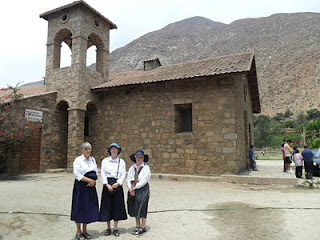
The shrine occupies a large area and is enclosed by an iron pallisade put in place by Vincentian Fathers. In addition to Rosa's house and the chapel, there is a large retreat house. Sr Clara brought a group of forty young people in the past for a retreat here and said it was excellent. On the day of our visit, sadly, we were all sorry to see how neglected and poorly maintained the site is, probably because there is now no group of religious living there.

Srs Anne, Rose and Clara outside the Chapel where Rosa was confirmed.

Chica de Jora stall just outside the sanctuary - a refreshing local drink made from maize and wheat


Flowers in the village


A goat on her knees in the grounds of the sanctuary - perhaps in prayer?

The Priest who said Mass for us blessing someone's new car after the Mass


Sr Anne kindly treated us for lunch in one of the semi-open-air restaurants that serve pilgrims and visitors. I was privileged to try a Pachamanca, a Peruvian speciality prepared by burying the meats in the earth to cook on hot stones. The meats were served with potatoes cooked in their skins, corn on the cob, broad beans and finely sliced onions garnished with lemon-juice. It was a great feast. We were advised to share one between us, but even so there was so much left over that we had enough for Monday's lunch!


Brigid, Sr Clara and Sr Anne at lunch

I had anticipated a day of both great blessings and challenges. This turned out to be so, but not in the way I had thought. I expected extreme heat, but we were blessed with lovely coolish, breezy air. It was not at all hot or uncomfortable. I had expected to be plagued with mosquitoes even if we used repellent, but apart from one little bite at the beginning of the journey (Brigid), and one on arrival (Clara), we were remarkably free from insect trouble. Finally, the joy of praying in the very place where Santa Rosa lived her formative years and took the name of Rosa at confirmation outweighed any small inconveniences.


Sr Rose sitting on the wall outside the sanctuary with the view from Quives behind

by Sr. Rose of Lima

Thursday, 24 February 2011

Franciscan Retreat at Manchester University


On 11th-13th February, the FAV Team (Franciscan Animators for Vocations) were invited to give a Franciscan Retreat for the Catholic Chaplaincy of the University of Manchester. This was co-ordinated by Sr. Oneng. The team included Srs. Clare Bernadette FMSL, Teresa FMSJ,  Oneng FMDM, Br. Paul OFM Cap and Br. Antony OFM.


They were kindly hosted by Rev. Ian Kelly and the Cathsoc and accommodated by the neighbouring OFM Conventual and FMSJ communities.

The theme of the weekend was 'First Things First'. This retreat included opportunities for Mass, Adoration, Confession, workshops, discussion, prayer and reflection. Br. Paul introduced this theme with his opening Mass and workshop on Friday evening. This dealt with the challenge of putting God first in one's life – in practice as well as in desire. In his workshop, Br. Paul explained how St. Francis put God first. Through meditation, he entered into the mystery of Christ by a threefold path, focusing on the Incarnation, the Passion and the Eucharist.
During Mass on Saturday morning, Br. Antony led us to reflect, through the Gospel story of Martha and Mary, on how our busyness can cause us to miss Christ present to us in the present moment. He also led us to question whether God is always our inner motivation for serving others.

Later in the morning, Sr. Oneng's workshop delved into the profound conversion which St. Francis underwent when he decided to kiss a person he would have normally avoided at all costs – a person suffering from leprosy. Oneng explained how, after seeing Christ in the leper, Francis' outlook was gradually changed so that he began to see Christ in all his fellow creatures. We were then challenged to befriend the 'lepers' in our own lives.
In between workshops and scheduled prayers, there was time for Franciscans and students to relax and converse together.


In the afternoon, Sr. Clare led a workshop about the relevance of St. Francis' spirituality expressed in his Canticle of Sir Brother Sun, to ecological issues facing today's world.


The group discussions considered the potential of a spiritual practice of poverty and outlook of humility in our efforts to live in harmony with the rest of creation.
In the evening, there was an open forum with students in which each member of the FAV team shared the story of their own vocation and the team answered questions from the retreatants. This session was resumed and completed on Sunday morning after Mass.


During the Holy Hours, Sr. Teresa helped us to get in touch with God through the prayers of St. Francis.
In the Mass of Sunday morning, Br. Paul highlighted the necessity of God's grace, not just our good works, to help us become the saints we are all called to be.
With some members of the Team including Srs. Oneng and Clare having to depart on their homeward journeys, there were some farewells and photos before lunch.

The retreat concluded that afternoon and evening with a workshop on Franciscan saints and an evening Mass.
FAV Team members commented that they enjoyed the weekend and appreciated the friendly welcome, enthusiastic participation and constructive feedback of the students and chaplaincy. They also enjoyed the Franciscan teamwork of the event. Thanks and God bless to all who enabled and prayed for the success of this retreat.


Sunday, 20 February 2011

Report from FMSL Mission, Santa Rosa, Lima, Peru

Sr. Rose at the Botanical Garden

I went with Bridgit to visit the local school in Santa Rosa where she has established a Jardín Botánico [Botanical Garden] to teach the children the importance of taking care of the environment and to deepen their awareness of the interdependence of all plant/bird/animal/insect life forms.


Bridgit, the environmentalist who set up the project and is teaching the children in Santa Rosa school.


The project started in 2007 with the back-breaking task of clearing the site which was nothing but rubble, stones and junk.

At first the project was held up by difficulties with poor soil quality. Later, a forestry engineer, Javier, became involved. With his help the children were able to grow more vigorous plants. Javier taught them the way to dig a metre square pit for each new tree or bush and then to fill it with rotting organic matter. This would break down to provide food for the growing plants. On top of this organic matter the children placed the soil that had been dug out, minus the large rocks. If a layer of good top-soil could be acquired it would be an added bonus, but if not, no problem.
The garden was planned to include various plants that would provide both colour, perfume and homes for insects and birds.

During my visit, Bridgit, picked five different plants to review with the children:
1. Madre selvas [honeysuckle]. This has a profumo muy rico [very rich perfume] and so it scents the garden and is delightful. It is a plant que trepa [that climbs] so it could be trained to cover parts and make an arbour.
2. Jazmín [jasmine].This also is a climber with a lovely smell.
3. Bougainvillea. This plants has brilliant colour. It can be red, white, pink, purplish or orange. In this garden it is rosado [pink].
4. Palo Verde [Green Post]. This plant actually seeded itself in the garden. It grows so easily everywhere as to be almost a weed! Nevertheless it has a lovely green tronco [trunk] which gives it its name. It also has pretty yellow flowers.
5. The last plant we looked at was the Moye Costeño. It has been planted to make a little avenida [avenue].It is in bud at the moment and it flowers will become red berries that birds feed on.
6.
Bridget is also teaching the children about Hydroponic Gardens. The word comes from two Greek words meaning water and grow. It is a system of gardening which can be operated in small spaces with no soil. Seeds are supported in sand from the river that has been washed and bleached. The seed germinates and when it has three leaves it is transplanted into pure water. The stem is put through a little hole in s tyro-foam which then floats on the water. The final stage is to transplant this in little plastic cups that sit in the water. I saw the children cut hole in the sides of the plastic containing lettuce seedlings in order to insert small drainage pipes into the sand.

Finally the children set up a simpler hydroponic garden for maize. They lined boxes with black plastic and stapled them firmly. Then they put a couple of inches of water in the boxes and sprinkled them with seeds. They will take these home, cover them with newspaper and make sure the seeds do not dry out.


I thought these activities were highly enjoyable for the children. Bridgit went out of her way to impress on the children that learning is not just from books in classes, but can have an important practical dimension. Doing this kind of project could be the beginning of a good career studying horticulture and they might become a Forestry Engineer like Javier. Since these children were doing summer school recuperación because of poor grades in science/maths, the hope was that they would be encouraged to take more interest in their studies.
It was good to see the children learning about the importance of plants and the concept of urban forest as “the lungs of the city”.
by Sr. Rose of Lima

Wednesday, 29 December 2010

Willie's 75th Birthday Celebrations


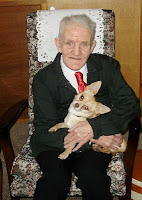
Above: Willie with his wee friend Maximus

December 7th was Willie's 75th birthday. Willie who lives in the caravan on our grounds has been with us for nearly 40 years and it is a miracle that he is still alive given his earlier lifestyle. Anyway we had Mass for him up at the Study Centre and then a celebration meal for him with all the students, staff, all of us here at the convent, - and the Parish Priest who has known Willie all the time he has been with us. Philippe who is the Principal of the Study Centre was the Presider at Mass and he has known Willie for some years.


Left: Willie at lunch with Parish Priest Canon Bunce and FISC Principal, Br. Philippe


Right: Winnie reads Psalm

Below left: 
Br. Ninian reads the Gospel


It was a great celebration. Some of the students did a liturgical dance for the presentation of the gifts during the Mass with African music and drums. They had some form of African garment on for the occasion even the blokes! After the homily Philippe made reference to the story of when Archbishop Carey was being installed/inaugurated as Archbishop of Canterbury. On that great day there was a mammoth procession for the Cathedral after the ceremony with all the dignatories and VIP's etc - and at the end came the new Archbishop in all his glory: grand vestments, mitre etc etc etc. Up pops Willie from the crowd and goes right up to the Archbishop, tugs at his sleeve and boldly asks: “When are you going to give us our Cathedral back?!”
Funny story yet true. Philippe continued to explain how Willie has been a part of the life of the Centre since its beginnings. The Mass was beautiful.

Since mince is Willie's favourite food, we had shepherd's pie as the main part of the meal. A friend and neighbour had made him a cake and iced it with green and white icing as he is a Celtic supporter.


He proudly blew out his candles and enjoyed every moment of the day.


Above Centre: Willie with his old friend Br. Brendan

Above left: Willie with Sr. Clare and with Sr. Elizabeth before Mass

Below: Willie Enjoying his cake, cards and gifts at Monte Bre


Below Left: Max ran off with one gift to open himself!


It certainly was a huge landmark in Willie's life and it was an appropriate day to remember the earlier sisters who cared for him:
Sr Agnes, Mother Angela, Sr Immaculata and Sr Paschal. They are now enjoying their eternal reward and smiling down on him. A great day was had by all.

by Sr. Elizabeth

Monday, 20 December 2010

News Update from Sr. Rose

Statue of St. Joseph and the child Jesus outside the Mother House
Since the end of September I have been at the Mother House, St Joseph's Convent, Littlehampton. I have been researching into homelessness in Littlehampton and the surrounding towns. I have also been studying Spanish from CDs in preparation for my trip to our mission in Peru in January. In addition, I help out in the sacristy and refectory and in the work of hospitality at St Joseph's.

Below: Sr. Regina, whom I help in the sacristy


Sr. Fabian, whom I 

help in the Refectory


From 28 November – December 4 I joined the lovely retreat given by Bishop John Crowley in St Joseph's. There were two talks a day based largely on the Gospel of the day. The talks were very clear and easily understandable and at the same time full of richness, wisdom and depth. I found a wealth of material to ponder and reflect on.

Bishop John Crowley in St. Joseph's Community Room
I will mention only two things which impressed me. The first concerns friendship. Our friedship with each other needs much the same elements as our friendship with Christ. Bishop John highlighted four essential ingredients for deepening intimacy between friends:


time
self-disclosure (so that one becomes vulnerable)
listening
affection.
The second point concerns ministry. Bishop John said that it is the most Christ-like ministry to encourage others. I felt very happy to hear this. I felt that everyone is therefore able to be Christ-like because it is a simple matter of choice to look for what is good in another person and to focus on that and take joy in it.

The retreat was open to sisters from our other houses and to secular Franciscans and to friends.

Sr Stanislaus visiting from our convent in Knock,with her Benemerenti medal and certificate which were presented during the course of the retreat to the surprise and delight of all, including Sr Stanislaus herself who knew nothing of this impending distinction!


Sr. Stanislaus with her Benemerenti medal and certificate

For my research into homelessness I recently visited St Anne's, a Christian Day Centre for homeless and lonely people in Brighton. One of the volunteers, Trevor, met me at the station and took me to the centre in Kemptown where I was greated with great warmth and openness. I chatted briefly with Anthony, who manages the centre, before being allowed to mingle with those present. For me this was a grace-filled and memorable time.


Anthony (front) with a few clients and volunteers

My latest visit was to St. Joseph's Night Refuge just outside Chichester, which is run by the charity Stone Pillow. On a previous visit I had been shown round The Old Glassworks a day centre for the homeless in Chichester, another Stone Pillow project. I am very grateful to the Stone Pillow staff who gave me their valuable time to help me understand their work and to enabled me to get some understanding of the complex issues involved in homelessness.


Staff and a volunteer in the sitting room of St Joseph's Night Refuge.


At the moment I am spending a few days back in Canterbury. It is lovely to be here again. To make up for my having very sadly missed Willie's grand 75th birthday Mass and lunch at FISC on December 7th, we had another mini-celebration in Monte Bre sitting room with tea and a cake.
Willie and Sr. Rose